Our first official U3A short walk started from the Hucknall tram stop car park (plenty of space currently).
15 members walked in 2 smaller groups with a 30/40m gap between them.
Our route took us through a short section of the Papplewick Green estate before taking the ‘yellow brick’ bridleway alongside the Leen Valley golf course before branching off to the footpath alongside the River Leen which emerges on Papplewick Lane.
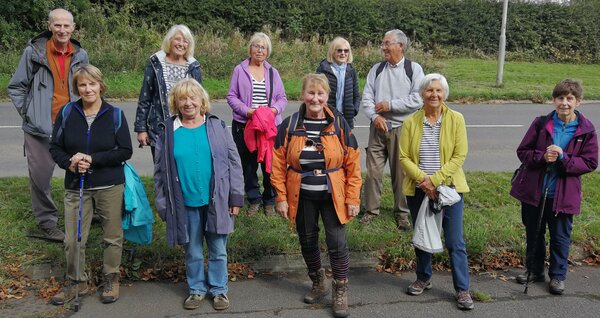
The next 2 sections were Moor Pond Wood and Papplewick Dam Wood where we stopped for a group photograph. From 1782 to 1828 the power of the river was harnessed for cotton spinning at Castle Mill .Cutting edge technology in its day. A meander up a gentle slope took us into Papplewick Church for a look around and a drinks stop.
The final section was through Linby village and across to The Ranges, the former Linby Colliery spoil heap, now redeveloped as country/recreational park. At the top there are expansive views in all directions.
Next Walk: Thursday, September 17th, 2020 – details later.
The photograph background is the waterfall at Top Upper Dam. The group are standing apart or in households.
To contact David Rose, the group leader, please use the form below:-
The online Zoom Monthly Meeting – 10.00 am, September 9th, 2020.
Agenda: Part 1
1. Welcome to the meeting – David Rose
2. Introducing the 2020 to 2022 committee members and their roles – Committee
3. An update on Covid-19 guidance and the impact on U3As – David Rose
4. Information about Group activity during lockdown – Siobhan Lee
5. Looking ahead in a changing environment – David Rose
Part 2
We are pleased to have member Bob Gow who will be taking us a walk through:
‘A short history of Bestwood from Royal Hunting Grounds to a Hive of Industry and Commerce’
Bob, as some of you will know, is heavily involved with the restoration and upkeep of the
Bestwood Engine Winding House which is the last remaining part of a vanished colliery and a relic of Victorian industrial engineering. Before all this came Nell Gwynne and Bob, much like Nell, will be revealing all.
ACCESSING THE MEETING WITHOUT THE INTERNET or ZOOM
This is a Zoom event however if you do not have Zoom, do not like Zoom or have Zoom fatigue then the meeting can be accessed by phone. It is your normal call rate (they are not premium numbers) It allows you to join in and listen to the meeting.
How to access
If you do not have an internet connection you can join the meeting by telephone.
Dial any one of the standard rate numbers below:
0203 901 7895
0131 460 1196
0203 051 2874
0203 481 5237
0203 481 5240
When prompted enter the meeting ID, which is 718 4497 8566, followed by #
When prompted for Participant ID, press #
When prompted for the meeting password, enter 136162, followed by #.
You will then be in the meeting.
To mute / unmute yourself during the meeting press *6
Because the Library was closed, we had not been able to pick up a set book to read during August so the suggestion was for another Classic book from our personal bookshelf. Those who chose to read a Classic again included the following books:-
Cider With Rosie – Laurie Lee; Jane Eyre – Charlotte Bronte; The Old Man & The Sea – Ernest Hemingway; Persuasion – Jane Austen and although not really a classic – Forever Amber – Kathleen Winsor, which was one of the first of its type many years ago.
This month, if the library is open, then we hope to read any Alan Bennett book or if not, our favourite crime writer. Reports on these next month.
Once again, even though the Creative Writing Group has now closed, I thought you might be interested in the following which was first written in February, 2016. We were told to choose a scene and write about it.
BLISS!
It had been a pleasant summer’s day, that Wednesday in July, not sunny but warm. The Hucknall U3A Lunch Group had had a lovely three-hour cruise and lunch down the River Trent on the Nottingham Princess Riverboat. It had been a much more relaxed lunch than our usual monthly event as, after the lunch itself was over, instead of disappearing home straight away, we all sat on deck and watched the world go by. We marvelled at the expensive looking homes built on the riverside and at the crudely made nests also built on the riverside. Cyclists waved to us from the Victoria Embankment, rowers scowled as we broke their concentration and swans and Canada geese quickly swam away from the eddies made by the riverboat.
Eventually it was time to go home, back to our usual early evening activities. I watched some television until it became dark and, being bored, flicked from channel to channel to find something worth watching. And there it was, a BBC Four programme called “The Canal Trip” which had been filmed in real time and contained no commentary, music or presenter and showed nothing more exciting than passing boats, changing scenery and the occasional passer-by in the distance walking along the towpath. I started to watch, wondering when the commentary would begin – but it didn’t. Surely something would happen soon, I asked myself?
I continued to watch, becoming mesmerised by this experiment in slow TV filmed down one of Britain’s historic waterways, the Kennet and Avon Canal. The programme, which switched from colour to black and white, featured facts about canal construction which appeared on the water in text, a very original idea which negated the need for a commentary. I checked how long the programme would be on for and was quite surprised that it would last for two hours. Two hours! Could I really sit and watch this programme for two hours? But I was so hypnotised by the sounds of the birds singing, the crunch of approaching cyclists’ wheels on the gravel, the wind rustling the leaves which overhung the canal and the slow-moving background and interesting facts emerging from the water that I just sat back and enjoyed it. It was such a lovely coincidence that we had been on our own trip on the water earlier that day.
Later I wasn’t surprised to find that thousands of other viewers had felt exactly the same way as I had about the programme. Apparently, the show fetched 506,000 viewers and had a peak of 599,000, well above the BBC Four slot average of 340,000. Britain has so much to offer, whether it be these canals, the Lochs of Scotland, the Peak & Lake Districts, or the Yorkshire Moors. Wouldn’t it be great if the BBC made a whole series of these films and encouraged people to visit places that might even be on their own doorsteps or just an hour or so away. No need to spend money on an expensive trip to Venice in order to visit the Grand Canal, not when the Kennet and Avon Canal is on your doorstep! With the help of films such as this and the hard work of the Canal Conservationists, it is hoped that the future of even the grottiest canal’s future is ensured for the benefit of all.
We continue with our Zoom meetings and with Italian. We had the challenge of a map of part of Rome to answer questions on places and directions, to varying degrees of success, accuracy and depth of information. Anyway, we got through!!!
Our next meeting will be on 10th September at 10.30 am and we are trialling an hour session. This will be a quiz on Italy and kindly organised by Liz. We shall continue to Zoom each month on the second Thursday of the month at 10.30 am until Christmas. Then review the situation as any developments unfold.
We hope all who manage to have some kind of holiday break have a great time and keep safe. To those not zooming, we hope you keep well and we miss you. Take care one and all and keep safe and sane!!
To contact Liz and Ann, please use the form below:-