Science

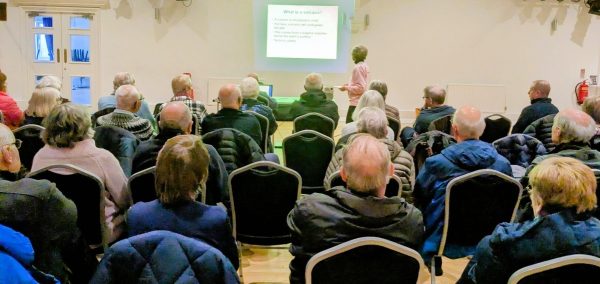
At the September meeting we welcomed Isabel (Izzy) Ely a postgraduate researcher at the Nottingham University Faculty of Medicine and Health Sciences Centre ofMetabolism, Ageing & Physiology (COMAP).

This is part of theAcademic Unit of Injury, Recovery & Inflammation Sciences School of Medicine who are based at Royal Derby Hospital.

She outlined the current research into the effect of ageing on our muscular system. Generally as we get older we exercise less and invariably eat less protein.

These factors can lead to muscular atrophy (wasting) and her research is looking at the effect of an amino acid supplement in reversing and slowing down this process with a focus on the older generation.

Next MeetingFriday October 20th 10.00am to 11.45 am

Part 1: ‘The Greening of the Nottinghamshire Coalfields’ by David Vincent

From his own personal and professional involvement David will explain why and how this came about.

Part 2: An introduction to the science and development of photography – DR

David Rose

Science

We meet on September 15th at 10.00am in the main hall at John Godber Centre. I am pleased to report that we have a guest speaker, Isabel (Izzy) Ely, who is a postgraduate researcher at the:

Centre of Metabolism, Ageing & Physiology (COMAP) Academic Unit of Injury, Recovery & Inflammation Sciences, School of Medicine, Faculty of Medicine & Health Sciences University of Nottingham, Royal Derby Hospital Centre

In her own words this is the rationale of study that she is currently undertaking.

The loss of skeletal muscle mass (known as atrophy) is an undesirable feature of many disease and scenarios including ageing, cancer and reduced physical activity from illness, injury or increased sedentarism. One mechanism thought to influence age-related muscle mass loss is “anabolic resistance” which leads to a reduced muscle building ability in response to protein feeding and exercise. As such, the search for optimal exercise and/or nutritional strategies to combat this anabolic blunting effect remains a hot-topic in scientific research.    

The study focus

The study I am currently running is focused on a specific amino acid (the building blocks of protein) called leucine which is thought to be the most important amino acid for stimulating the muscle building process. We are investigating whether there is a dose-response of muscle protein building to “super whey” protein (a protein drink with a greater portion of leucine) at rest and during acute exercise.

I have to admit to a vested interest as I am one of the ‘specimens’ being tested.

David Rose

Science

We were pleased to welcome a guest speaker, Mr Ian Allen, at our July 15th meeting.

Ian is a local wildlife enthusiast who contributes to the county and national surveys on sighting, frequency and the identification of dragonflies and damselflies in our local wetlands.

He explained with the help of some wonderful photographs that:

Damselflies are delicate insects, with eyes on each side of their rectangular head. They have a fluttering flight, with the front and back pairs of wings equal size. When the damselfly is resting, the wings are usually held closed.

 Dragonflies are larger and more robust, with eyes that meet in the middle of their spherical head. Their front wings are narrower than their hind wings and when resting both pairs are held wide open

Male banded demoiselle damselfly

                          Female emperor dragonfly

They are to be found in all wetland areas throughout the summer months.

Ian was thanked for his presentation and was able to answer questions from members.

No meeting in August but we meet again on Friday September 15th in the main hall of the John Godber Centre.  Enjoy the break and there will be more details before the next meeting.

David Rose

Science Group

The June 16th meeting was led by John Tedstone ably supported by Terry Hill. 28 members ventured out on a very warm day.

John’s topical presentation about the current state of our water supplies and the rise in pollution of waterways and the sea due to untreated discharges led to some lively discussions.

Shades of ‘Mrs Merton’s heated debate with participants putting forward a case for or against what the water companies should or should not be doing even if it wasn’t their personal belief.

Discharging into the Trent

Our trip to Magna has been cancelled so we will meet at the John Godber Centre on Friday 21st July 10am to 11.30 this month

We have a change of room as the main hall is in use – We will be in The Bailey Room (downstairs)

We have a guest speaker- Mr Ian Allen

 Ian is a local expert, photographer and data collector of dragonflies and damselflies which are beautiful, graceful flying wetland creatures, belonging to the Odonata order of insects. They’re incredibly ancient, and date back to prehistoric times when giant versions the size of eagles roamed the skies. We will learn more on the 21st

We will take a summer break in August and reconvene on Friday September 15th at 10.0am JGC.

David Rose

Science

Bob McEwen led the session essentially around a theme of thinking and problem solving.

Some of the tasks were theoretical thinking problems and Bob also introduced some of a practical nature .Working in small groups we began to use (initially subconsciously) some of the keys to problem solving including:

Communication:  Actively listening to each other: Analysing the problem/situation

Creativity: Dependability: Decision making and the beginning of Team-building

Overall it was an enjoyable, active and fun learning session.

We then watched a short video and a PowerPoint about Brackenhurst College which is now part of Nottingham Trent University. We are making a visit to Brackenhurst on July 21st for a tour a talk and lunch.

Next Meeting Friday 15th June 10.am

John Tedstone will be discussing Pollution with a focus on water, rivers and the sea.