

Covid-19 Vaccine Scam
Fraudsters are taking advantage of the COVID-19 vaccine rollout through a cruel but convincing text in an attempt to steal people’s personal and financial details. The text contains a link that leads to a very believable but bogus NHS website with an application form to register to take the vaccine.
A member got in touch today when they received a text message purporting to be from the NHS. It confusingly stated that “we have identified that your are eligible to apply for your vaccine” and advised him to follow a link to get more information and ‘apply’:
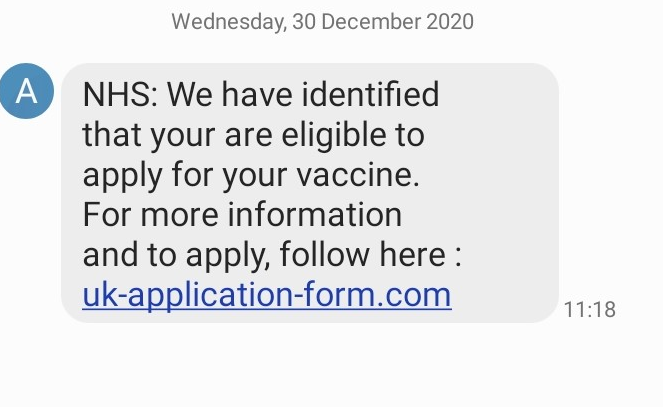
This URL(in blue) takes you through to an extremely convincing fake NHS website that asks for your personal details, but the member became suspicious when it asked for his bank/card details in order to ‘check his identity’. It was then that he began spotting spelling mistakes on the site and in the SMS itself e.g. ‘your are’ which are classic signs of a phishing scam.
Remain vigilant of coronavirus scams
We know that criminals will use the confusion and urgency around the pandemic as a way to target potential victims. With the recent approval of multiple vaccines in the UK, these types of scam attempts are likely to continue as fraudsters look to take advantage of the rollout to so many people.
Cold calls regarding the vaccine are also beginning to take place – I’ve already had reports of scammers asking people to pay for it over the phone. If you receive one of these calls, hang up. If you think you may have handed over your card details to scammers, let your bank know what’s happened immediately.
David Rose
Where am I? – useful App
With more people out and about at the moment, a useful App to know about is called ‘what3words’. The world has been divided into 3 metre squares, and each square has a unique identifier, using 3 random words. For example, Hucknall Market Place is ‘acted.engage.lowest’.
The App can be downloaded onto your phone, and any location can then be found on the map grid, and also on satellite view. The phone GPS needs to be on, then this location can be given to the 999 service – it is much quicker than trying to read an Ordnance Survey map on top of Kinder Scout, and when not on a road or a known location.
Our walking groups take great care not to get lost, but this would be useful in an emergency, particularly in an area with no particular landmarks.
John Tedstone
2020 Christmas Tree Festival
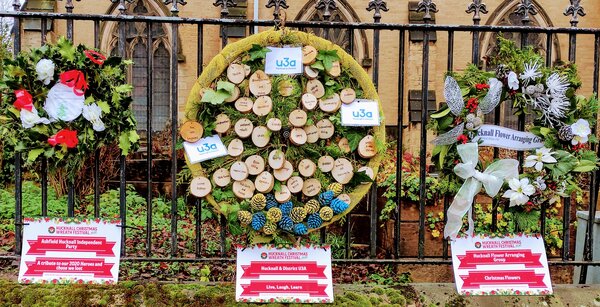
This 2020 Hucknall Christmas Tree Festival, which is usually held inside the church, was cancelled due to Covid restrictions. However in its place there is a Christmas Wreath Festival with the 34 wreaths made by local schools, businesses and community groups displayed on the church railings alongside the market place. Our wreath designed and created by the Groups Coordinator Siobhan celebrates our Interest Groups.
Scam – Fake PayPal E-mails
A current Scam Warning – Fake PayPal E-mails
Action Fraud is warning people selling items online to be on the lookout for criminals sending fake PayPal emails.
• Between January 2020 and September 2020, 21,349 crime reports were made to Action Fraud about fake PayPal emails.
• Victims reported losing a total of £7,891,077.44 during this time.
• Those targeted included people selling jewellery, furniture and electronics via online marketplaces.
• Reports of fake PayPal emails to Action Fraud made up a third of all reports of online shopping and auction fraud during this period.
How does it happen?
Criminals have been targeting people selling items online, by sending them emails purporting to be from PayPal. The emails trick victims into believing they have received payment for the items they’re selling on the platform.
Typically, after receiving these emails, victims will ship the item to the criminal. This leaves them at a further disadvantage having not received any payment for the item and also no longer being in possession of it.
How can you protect yourself?
• Sellers beware: If you’re selling items on an online marketplace, be aware of the warning signs that your buyer is a scammer. Scammers may have negative feedback history, or may have recently set up a new account to avoid getting poor feedback. Don’t be persuaded into sending anything until you can verify you’ve received the payment.
• Scam messages: Don’t click on the links or attachments in suspicious emails, and never respond to messages that ask for your personal or financial details.
• How to spot the difference: A PayPal email will address you by your first and last name, or your business name, and will never ask you for your full password, bank account, or credit card details in a message.
If you think you’ve been a victim of fraud, report it to
Action Fraud online at www.actionfraud.police.uk or by calling 0300 123 2040.