September 2021 – Scams

Telephone Text Scams – Why text scams are so prevalent

According to a recent survey, three in five of us have received a fake text claiming to be from a delivery company in the past year. The reason why text messages are frequently used by scammers is because sending them doesn’t rely on an internet connection, like a WhatsApp message does, and they don’t have to pass a spam filter like an email. Texts are also less likely to be missed, and many legitimate organisations use a text message to contact customers.

How to protect yourself from text scams
-Don’t follow any links
The most effective way to avoid text scams is to ignore links. Clicking on links could lead you to download malware and malicious software.
– Don’t share personal information
Treat all messages requesting sensitive information with suspicion. Legitimate organisations will never text you to ask for your personal or banking details.
-Contact the organisation directly
If you’re unsure, contact the company that claims to have sent it. Use the official contact details listed on their website.
– Don’t reply
Replying to a fake text, calling the number or clicking suspicious links only lets scammers know your number is being used.
-Report it
You can report fake texts by forwarding the message to 7726, which is a free reporting service provided by phone operators. This information is then shared with police and intelligence agencies.

David Rose

Message from our Chair

Hello to all members,
In what seems like no time at all we have reached August. The school holidays are in full swing and for many of us it means spending time with and entertaining our grandchildren. Many of you will be experts on White Post Farm, Wheelgate, Rufford and other country parks, Crich Tramway Museum and many more places where youngsters can run free. Little wonder that by September we are ready for a holiday.

I recently read a book called ‘Tales of Old Nottinghamshire’. One of the chapters is about Sir Thomas Parkyns who lived in Bunny Hall. He was born in 1663, and educated at Westminster School and Trinity College, Cambridge. He studied law at Gray’s Inn, was a lover of Latin, and had knowledge of mechanics, mathematics, and architecture. A fine athlete, he never had a day’s illness until he was 78, and even in middle life he was a good runner.

But his fame lay in his love of wrestling. He is remembered as the Wrestling Baronet; he called himself Sir Thomas Luctator. He established an annual wrestling match in the village for which the prize was a gold-laced hat, and the practice was kept up for nearly a hundred years after his death. The last competition took place in 1811 – and this is what caught my eye. A man named Butler from Hucknall Torkard was the last winner of the prize.

u3a Monthly Meetings
Many of you will be aware that we can no longer meet at the leisure centre. September 8th will be our first live meeting since March 2020 and it will be at the John Godber Centre (JGC). The committee are meeting there on Wednesday 1st September and one our objectives is to finalise the meeting arrangements. Full details will be in the September Newsletter. It will be an opportunity to mingle socially whilst maintaining some level of social distancing, ventilation and hand hygiene.

Maureen Newton has kindly agreed to do an interactive presentation with a local flavour where your questions and contributions will be most welcome.

Finally – there is no formal meeting in August but do zoom in to Melvyn’s arranged talk on Wednesday, 11th August ‘What’s the problem with sugar’.

David Rose

3rd Age Trust -Push Back Ageism Campaign

Have you or any of your friends and family had to use a walking frame? If so you may have some observations to share about their design and use. How to do that is explained in the following article.

One of the aspects of the Trust’s Push Back Ageism Campaign, working in partnership with the Design Age Institute, is to challenge the designers of products and services which will make life easier for older adults to design products which are appealing and attractive to use, rather than just being based on need.

One initiative within the Design Age Institute is ‘This Age Thing’, which was set up to bring together a community of designers, businesses, service-providers, researchers, policy makers and older adults to celebrate ageing and amplify positive stories about getting older, but also to challenge designers. They are currently gathering information about the design of walking frames and being able to quote from peoples lived experience and real-life situations adds strength to the challenge. Also, as part of that, the Helen Hamlyn Trust has issued a challenge to young designers at the Royal College of Art to design a walking frame that will look good, but also be fit for purpose. Apparently, 87% of falls in the USA are caused by people falling over with their walking frames, which are very similar in design to those, available in the UK.

Do you have a story to tell about walking frames, either their use or their design? Would you be happy for us to use your story? We will, of course, ensure that you remain anonymous; we will never reveal your name or any contact details.

If you have a story that you would be willing to share, please send it to me by 20th August: sandi.rickerby@u3a.org.uk
Thank you.

Sandi Rickerby
Trustee for the North East
Chair of the Push Back Ageism Working Group

How do we know if something is a scam?

One of the most important things to remember is that if something seems too good to be true, then it probably is.

Other warning signs are:
• Someone you don’t know contacts you out of the blue
• You’re asked to give away personal information like passwords or your PIN
• You’ve been asked to transfer money quickly, often to solve a problem you didn’t know you had
• Someone refuses to confirm the company or organisation they are contacting you from
• Email addresses or links within an email don’t look right

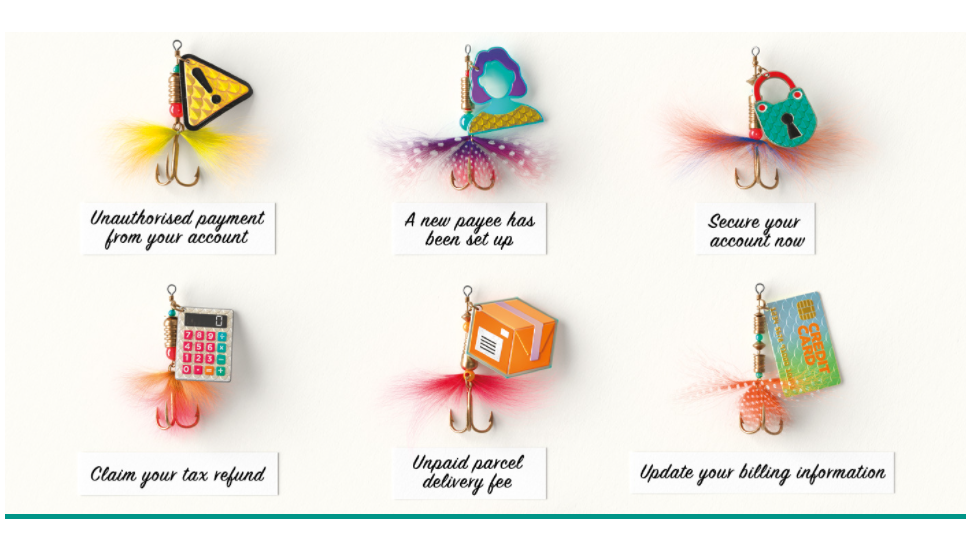
How do scammers dangle bait to fish (phish) for information?
Phishing – a term coined in the mid-1990s to describe how scammers dangle bait to ‘fish’ for passwords and other sensitive data – is still the most effective line of attack. Fake emails, text messages (referred to as smishing) and phone calls (vishing) aim to trick you into thinking you’re dealing with a genuine company.

Examples:

David Rose

Message from the Chair – July 2021

Hello everyone, I hope you are enjoying the warmer summer weather. I especially like the weeks around the summer equinox on 21st June when dawn starts really early and the evenings are so light. So, while still being extra Covid variants careful, I hope you are enjoying the warmth, the great outdoors, the garden flowers and the displays of wild ones around many of the local footpaths and grass verges.

Several of our groups, many of them the sports/outdoor groups, have re-started which is great news and we hope to support more activity over the coming months. I know that many members are looking forward to meeting up again soon with the friends made in our various u3a groups to enjoy our shared interests in person.

We are pleased to have a new group ‘Indoor Short Mat Bowls’ starting on Monday July 5th, 2pm to 4pm at a new venue, The United Reform Church Hall on Farleys Lane.

Since it is also the holiday season I have found a postcard from about 100 years ago which shows a comic seaside scene.

Many were produced by James Bamforth from West Yorkshire and one of the most celebrated graphic artists was Donald Fraser Gould McGill whose name has become synonymous with the genre of saucy postcards, particularly associated with the seaside. The cards mostly feature an array of attractive young women, fat old ladies, drunken middle-aged men, honeymoon couples and vicars. He has been called ‘the king of the saucy postcard’, and his work is collected and appreciated for his artistic skill, its power of social observation and earthy sense of humour. They were always a source of innocent blushes in those days and I remember being pulled away by concerned parents from the racks outside the novelty shops in Skegness.

The caption seems relevant as it looks like it will be a UK coastal holiday for most of us to enjoy this year –just like the couple on the card.

David Rose, Chairman